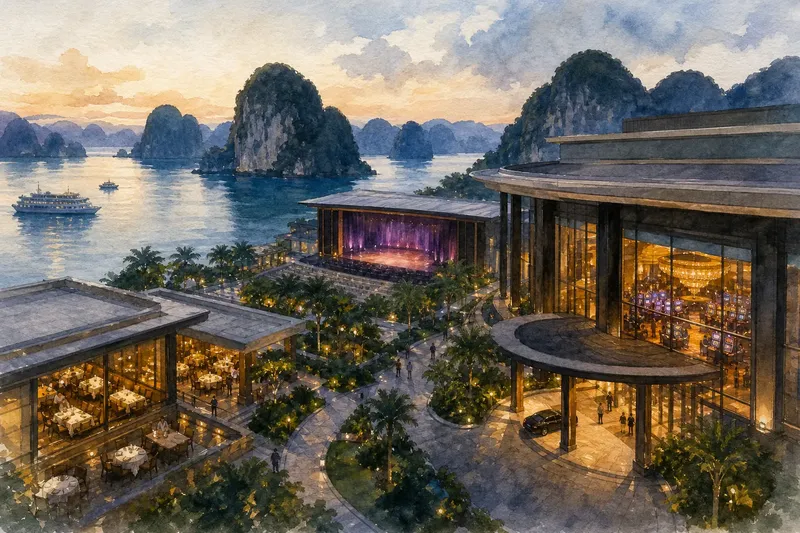
A Live Performance and a Table Game: Two Different Evening Plans
Compare a live performance and a table game in Hạ Long by atmosphere, venue rules and personal spending boundaries, then choose a plan that fits your group.

Choosing between a live performance and a table game in Hạ Long starts with a simple question: would your group rather share a show or take part in a game? The answer shapes the evening’s pace, conversation and practical arrangements.
What does each activity ask of the group?
A performance gives everyone a common focus. Companions watch or listen together, then have a shared subject to discuss afterwards. It tends to suit a group that prefers a planned event and does not need to make decisions throughout it.
A table game is more interactive. Some guests may play, while others watch or talk, if the venue’s rules allow it. That difference can split the group’s attention, so check whether the table setting suits both participants and observers.
Decide whether your group wants a shared story, active participation or a mix of the two.
How can you compare venues before choosing?
Check the venue’s current programme, admission arrangements and house rules directly. For a performance, confirm its start time, language or format, and any guidance on entering or leaving during the show. For a table game, ask which games are available, whether guests may observe, and what identification or eligibility rules apply.
Also consider the setting. A scheduled show may make conversation difficult until it ends; a gaming area may be noisy or focused on play. If either atmosphere would frustrate someone in your group, choose a different shared activity.
Which questions help settle the plan?
Is a performance a better choice for a group?
It may suit companions who want to focus on the same event and are comfortable following its schedule. If your group expects to talk or come and go, check the venue’s etiquette before booking.
Can guests watch a table game without playing?
That depends on the venue and the specific table. Ask staff before approaching, and choose another activity if observing is not permitted or comfortable.
What should someone decide before joining a game?
Set a personal spending limit using money available for leisure, and decide in advance when to stop. If you feel unable to stick to that boundary, do not play; a qualified support service or health professional can offer further help.
What if the group prefers different activities?
Compare the options against practical needs such as schedule, atmosphere and venue rules. If no shared plan fits, arrange separate activities rather than treating one person’s preference as the default.
What should you check before setting a leisure budget?
Use a clear boundary that does not depend on winning or continuing for someone else’s sake. These checks help turn a general intention into a decision:
- Check whether the money set aside is separate from essential bills; if it is not, do not use it for gaming, and choose a non-gambling activity.
- Check whether you can name the amount you are willing to spend before play; if you cannot, pause the plan and decide on a clear limit first.
- Check whether you would still be comfortable spending that amount if you lost it; if not, lower the limit or do not play.
- Check whether anyone expects you to cover another person’s play; if they do, refuse that arrangement and keep each person’s spending separate.
- Check whether you are tempted to borrow or use money intended for another purpose; if so, stop and leave the game rather than finding more funds.
- Check whether you can stop when you reach your limit; if you doubt that you can, skip play and consider speaking with a qualified support service.
How might the choice work in practice?
Imagine Mai and Quang have a hypothetical leisure budget of 600,000 đồng for an evening, with 400,000 đồng set aside for the performance and travel and 200,000 đồng as Quang’s possible gaming limit. They check the venue’s programme and confirm the show’s admission arrangements; Mai prefers to leave after it, while Quang remains interested in a table game. Before the show, Quang decides that the 200,000 đồng is the full amount he is willing to spend and will not add money if it is lost. Afterwards, he checks that the table permits observation and asks staff about its rules. Mai leaves as planned; Quang chooses whether to play within his stated limit or skip the game. The observable decision is straightforward: if the venue’s rules or his spending boundary do not suit him, he does not join; otherwise, he can proceed alone without changing Mai’s plan.
For a live performance and table game evening in Hạ Long, compare the programme and table rules before you set out, then make the spending decision separately from the group’s activity choice. That keeps the plan clear even when companions want different things.